The number that became a movement
Bill McKibben wrote The End of Nature in 1989, the first book about climate change for a general audience. The number 350 refers to 350 parts per million of CO₂, the upper safe limit for atmospheric carbon dioxide. Earth passed it in 198…

In 1989, a 29-year-old staff writer at The New Yorker published a book arguing that human activity had altered every square metre of the natural world. No wilderness was untouched. No weather system was uninfluenced. Nature, as a force independent of humanity, was over.
The book was called The End of Nature. It was the first book about climate change written for a general audience. Bill McKibben wrote it in a cabin in the Adirondacks with no running water. It has since been translated into 24 languages.
Three decades later, McKibben co-founded an organisation named after a number: 350. The number refers to 350 parts per million of CO₂ in the atmosphere, the threshold that NASA scientist James Hansen identified as the upper safe limit for a stable climate. Earth had already passed it. The organisation’s name was a statement of fact and a demand rolled into one.
01The book that started it
McKibben was born in 1960 in Lexington, Massachusetts, grew up in the Boston suburbs, and went to Harvard, where he became president of the Harvard Crimson. After graduating, he joined The New Yorker as a staff writer, one of the youngest in the magazine’s history.
He left New York for the Adirondack Mountains in upstate New York. There, in a small cabin, he wrote The End of Nature. The book’s argument was stark: the greenhouse effect meant that no part of the natural world existed outside human influence. Rain was not simply rain. Weather was not simply weather. Every system had been altered.
The book appeared in 1989, the same year the Berlin Wall fell and the Exxon Valdez ran aground in Alaska. Climate change was not yet a political battleground. McKibben’s contribution was to make the science legible to people who did not read scientific journals. He wrote clearly, without jargon, and with a sense of grief for what was already lost.
It sold steadily rather than spectacularly. Its influence was cumulative. Over the following decades, as the science confirmed and exceeded McKibben’s warnings, the book became a reference point: the moment someone told the public what was happening, in plain language, and was ignored.
02350: the number
In 2007, James Hansen, then director of NASA’s Goddard Institute for Space Studies, published a paper arguing that atmospheric CO₂ concentrations needed to be reduced to 350 parts per million to preserve a planet similar to the one on which civilisation developed. At the time, the concentration was already above 380 ppm. As of early 2026, it stands at approximately 424 ppm.
McKibben seized on the number. In 2008, he co-founded 350.org with a group of students from Middlebury College in Vermont. The name was the message: here is the line, and we have crossed it.
On 24 October 2009, 350.org coordinated simultaneous demonstrations in 181 countries. CNN described it as the most widespread day of political action in the planet’s history. The events ranged from marches in major cities to underwater cabinet meetings in the Maldives to banner drops on glaciers. The number 350 appeared in every photograph.
We are the first generation to feel the impact of climate change and the last generation that can do something about it.
The organisation grew quickly. By 2010, it had chapters on every continent and a volunteer network that operated in 188 countries. McKibben had taken a scientific threshold and turned it into a brand, a rallying point, and a test: either you accepted the science, in which case you accepted the number, or you did not.
03Fossil fuel divestment
In August 2012, McKibben published an article in Rolling Stone titled “Global Warming’s Terrifying New Math.” The argument was built on three numbers.
Two degrees Celsius: the maximum warming that governments had agreed was tolerable. 565 gigatons: the amount of CO₂ that could still be burned and stay within the two-degree limit. 2,795 gigatons: the amount of carbon contained in the proven fossil fuel reserves already on the books of coal, oil, and gas companies.
The implication was plain. The fossil fuel industry’s existing reserves contained five times more carbon than could safely be burned. Their business model required the destruction of a liveable climate. Any investor holding fossil fuel stocks was, in financial terms, betting that governments would never enforce their own climate commitments.
McKibben followed the article with a 21-city speaking tour and a direct call: universities, pension funds, churches, and governments should divest from fossil fuel companies. The strategic argument was not primarily financial. It was political. Divestment was a tool of delegitimisation, the same tool that had been used against apartheid South Africa.
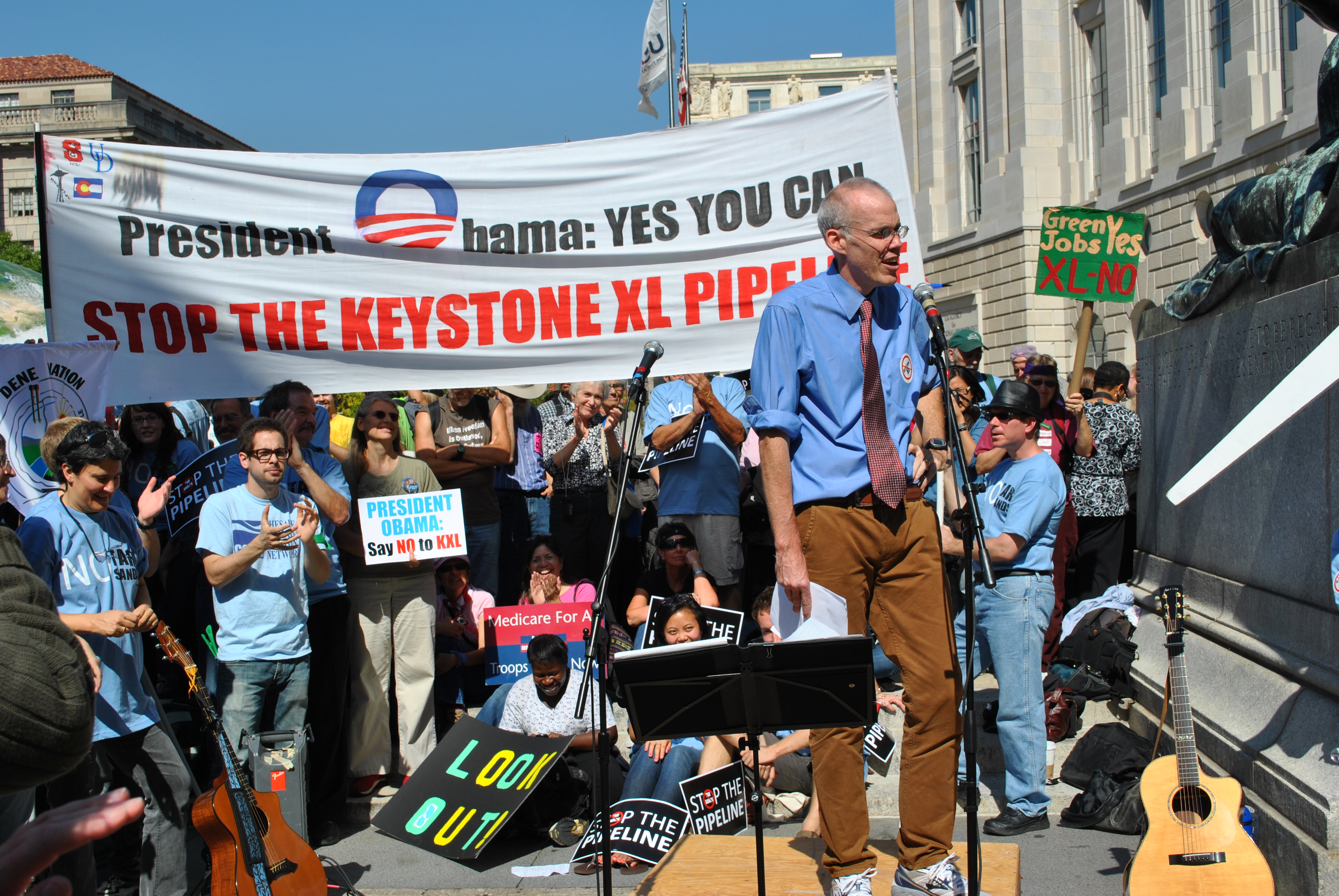
In 2011, McKibben had been arrested outside the White House alongside 1,252 others during a two-week protest against the Keystone XL pipeline, which would have carried tar sands oil from Alberta to the Gulf of Mexico. It was one of the largest acts of civil disobedience in modern American history. President Obama delayed the pipeline. President Biden cancelled it in 2021.
The divestment campaign grew faster than anyone, including McKibben, expected. By 2025, institutions managing more than $40 trillion in assets had made divestment pledges. The list included the Norwegian sovereign wealth fund, the New York State pension fund, the Church of England, Harvard University (after years of student pressure), and hundreds of cities, foundations, and religious organisations.
Whether divestment has materially affected fossil fuel share prices is debated. What it has done is shift the political framing. Fossil fuel companies went from blue-chip investments to contested holdings. Fund managers had to explain why they held them. The stigma was the strategy, and it worked.
04Cancer and continuing
In 2019, McKibben was diagnosed with prostate cancer. He wrote about it publicly, connecting the experience of confronting personal mortality with the larger project of confronting ecological mortality. He recovered after treatment.
He has received the Right Livelihood Award, sometimes called the alternative Nobel Prize, and the Gandhi Peace Award. He continues to write, organise, and campaign. His focus in recent years has shifted toward the speed of the energy transition: not whether renewables can replace fossil fuels, but whether the replacement is happening fast enough.
“Winning slowly is the same as losing.”
Bill McKibben · Falter: Has the Human Game Begun to Play Itself Out?, 2019McKibben is 65. He has been writing about climate change for 37 years. In that time, global CO₂ emissions have risen by more than 60 per cent. The concentration of CO₂ in the atmosphere has gone from 350 ppm, the number he named his organisation after, to 424 ppm. The planet has warmed by approximately 1.3°C above pre-industrial levels.
He is not an optimist in the conventional sense. He is a person who decided, at 29, that the most important story of his time was being ignored, and who has spent every year since trying to make it impossible to ignore.
If it’s a rort, we cover it.
- Wikipedia: Bill McKibben. https://en.wikipedia.org/wiki/Bill_McKibben. Born 1960, Lexington, Massachusetts. Harvard Crimson president. Staff writer at The New Yorker. The End of Nature published 1989, first general-audience book on climate change. Co-founded 350.org in 2008. Arrested at White House 2011 with 1,252 others protesting Keystone XL. Right Livelihood Award. Gandhi Peace Award. Prostate cancer diagnosis 2019, recovered. Decoding Biosphere fossil fuel divestment database: $40T+ in divestment pledges by 2025.
- Rolling Stone: ‘Global Warming’s Terrifying New Math’ (July 2012). https://www.rollingstone.com/politics/politics-news/global-warmings-terrifying-new-math-188550/. Three key numbers: 2°C warming limit, 565 gigatons remaining carbon budget, 2,795 gigatons in proven fossil fuel reserves. Fossil fuel companies held five times more carbon than could safely be burned. Triggered the fossil fuel divestment movement.