The girl who wouldn’t stop
Greta Thunberg sat alone outside the Swedish parliament on 20 August 2018. She was 15 years old and held a hand-painted sign reading Skolstrejk för klimatet. Within a year, 4 million people were striking in 161 countries. She addressed t…
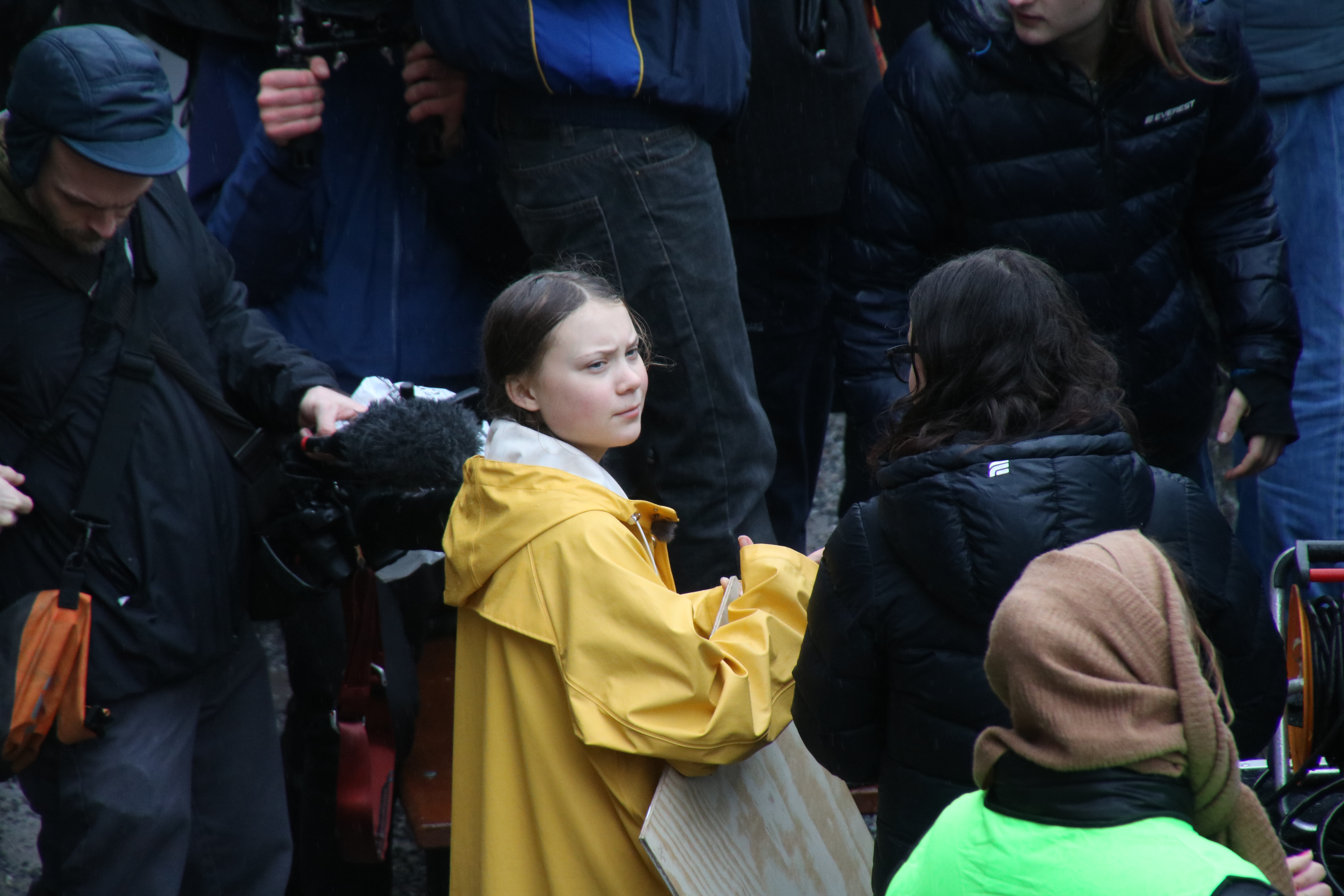

On 20 August 2018, a 15-year-old girl sat on the cobblestones outside the Swedish Riksdag in Stockholm. She wore a blue hoodie. She held a hand-painted wooden sign: Skolstrejk för klimatet. School Strike for Climate. She had decided not to attend school until Sweden aligned its climate policy with the Paris Agreement.
Nobody came. Not on the first day. A few photographers stopped. A couple of curious passersby asked questions. Greta Thunberg answered them with the same flat, precise delivery that would later unsettle heads of state: the science says the planet is warming, governments are not acting at the speed the science requires, she was going to sit here until they did.
Within weeks, students in other cities joined her. Within months, Fridays for Future had spread to dozens of countries. On 20 September 2019, an estimated 4 million people in 161 countries walked out of schools, offices, and homes in the largest climate demonstration in history. The girl on the cobblestones had become, without intending to and without a communications team, the face of a generation's demand that adults do what they promised to do.
Seven years later, Thunberg is 23. She has spoken at the United Nations, the European Parliament, the World Economic Forum, and the US Congress. She has been arrested multiple times. On 23 December 2025, she was arrested in London holding a placard reading 'I support the Palestine Action prisoners. I oppose genocide', under Section 13 of the Terrorism Act 2000, the provision concerning support for a proscribed organisation. Whether she remains on bail could not be confirmed as of 9 September 2026; her original March 2026 return date passed with no reported outcome. She has not stopped.
01The first strike
Greta Tintin Eleonora Ernman Thunberg was born on 3 January 2003 in Stockholm. Her mother, Malena Ernman, is an opera singer. Her father, Svante Thunberg, is an actor and producer. The family was comfortable, cultured, and, by Greta's later account, not particularly political.
Thunberg learned about climate change at school when she was eight. She became depressed. She stopped eating. She stopped talking. Her parents later described a period of several years in which their daughter essentially withdrew from the world. She was diagnosed with Asperger's syndrome, obsessive-compulsive disorder, and selective mutism.
The climate crisis became her fixed point. Where other children absorbed the information and moved on, Thunberg could not. The gap between what the science said and what governments were doing was, to her, an unbearable logical contradiction. If the house is on fire, you do not sit in the kitchen and discuss renovation timelines. You leave. You act.
The strike began three weeks before Sweden's September 2018 general election. Thunberg's original plan was to sit outside parliament every school day until the election. After the election, she continued on Fridays. The phrase Fridays for Future came from this pattern.
She had no organisation behind her. No funding. No social media strategy. She posted about the strike on Instagram and Twitter. Swedish media picked it up. International media followed. The simplicity of the act, one child sitting alone with a sign, proved more powerful than decades of NGO campaigns, celebrity endorsements, and policy papers.
02The diagnosis
Thunberg has spoken publicly about her Asperger's diagnosis since the beginning of her public life. She calls it her superpower. The framing is deliberate.
Asperger's syndrome, now classified under autism spectrum disorder, is characterised by intense focus, pattern recognition, difficulty with social conventions, and a tendency toward literal, direct communication. In Thunberg's case, these traits produced a public persona that was unlike anything the climate movement had seen: a teenager who said exactly what she meant, refused to soften her language for diplomatic audiences, and treated the gap between scientific consensus and government action as a moral emergency rather than a policy debate.
I don't want you to be hopeful. I want you to panic. I want you to feel the fear I feel every day. And then I want you to act.
Her critics used the diagnosis against her. Commentators accused her parents of exploiting a mentally ill child. Right-wing media figures mocked her speech patterns, her facial expressions, her intensity. Thunberg responded by leaning further into the directness. She did not smile for cameras. She did not moderate her tone. She told the World Economic Forum in Davos that she wanted them to panic.
The diagnosis also shaped her credibility with young people. For a generation raised on polished, media-trained spokespeople, Thunberg's unfiltered delivery read as authentic. She was visibly uncomfortable in public. She said things that made powerful people squirm. She did not appear to care whether they liked her. This was new in the world of climate advocacy, and it worked.
03The speeches that landed
Between 2018 and 2020, Thunberg delivered a series of speeches that entered the cultural record. Each one was short, factual, and furious.
At the UN Climate Action Summit in New York in September 2019, she told a room full of world leaders that they had stolen her dreams and her childhood with their empty words. The phrase 'How dare you' became a meme, a rallying cry, and a punchline, depending on who was quoting it. The speech was viewed hundreds of millions of times.
At Davos in January 2020, she told the assembled billionaires and heads of state that their financial system was built on a model that ignored the collapse of the natural systems on which it depended. She brought a set of numbers: carbon budgets, emissions trajectories, temperature thresholds. She was 17.
At COP25 in Madrid, she accused governments of creative carbon accounting and pointed out that national emissions pledges, even if fully implemented, would not limit warming to 1.5 degrees. She was not saying anything climate scientists had not said. She was saying it in a room where the people responsible for the failure were sitting in the front row.
The speeches worked because they were simple. Thunberg did not propose policy solutions. She did not negotiate. She read the science, stated the gap between what was needed and what was being done, and asked the people in the room to explain why. The format was devastating precisely because it left no room for the diplomatic language that climate conferences had used for decades to disguise inaction.
04From climate to everything
By 2021, Thunberg's activism had begun to expand beyond climate. She spoke about indigenous rights, economic inequality, colonialism, and the political structures that she argued made climate inaction inevitable. She described the climate crisis as a symptom of a broader system failure rather than a standalone policy problem.
This evolution alienated some early supporters. Climate centrists who had championed Thunberg as a useful voice for emissions reduction grew uncomfortable when she began describing capitalism as part of the problem. Fossil fuel industry allies, who had already been hostile, used the broadening to argue she was a leftist activist rather than a climate campaigner.
Thunberg appeared untroubled by the criticism. In interviews, she argued that it was impossible to address the climate crisis without addressing the economic system that incentivised fossil fuel extraction, that climate justice could not be separated from social justice, and that treating climate as a single-issue technical problem was itself a form of denial.
“You cannot solve a crisis without treating it as a crisis. And you cannot treat it as a crisis while maintaining the systems that created it.”
Greta Thunberg · Speech at Stockholm+50 conference, June 2022By 2023, she had been arrested at protests in Germany and Sweden. The charges were minor: disobeying police orders, blocking traffic. The arrests generated media coverage, which Thunberg appeared to consider the point. She was increasingly willing to use civil disobedience as a tool, moving beyond the symbolic school strike toward physical disruption.
05The arrests
Thunberg's arrest record grew steadily from 2023 onward. She was detained at a lignite mine protest in Lützerath, Germany, in January 2023. She was arrested outside the Swedish parliament during an action targeting fossil fuel permits. In each case, the charges were minor and the media coverage significant.
The December 2025 arrest was different.
Thunberg was arrested in London on 23 December 2025 outside the offices of Aspen Insurance on Fenchurch Street, holding a placard reading 'I support the Palestine Action prisoners. I oppose genocide,' at a protest connected to Palestine Action-linked hunger strikers held in UK detention. She was arrested under Section 13 of the Terrorism Act 2000 for displaying an item in support of a proscribed organisation; the use of a substantive terrorism offence against a climate activist holding a protest sign generated immediate international controversy.
Correction, 9 September 2026. This article originally stated Thunberg was 'detained' under Schedule 7 of the Terrorism Act 2000, a port and border stop power, and that she 'was not charged with a terrorism offence.' NBC News and Al Jazeera, both reporting on 23 December 2025, record that the arrest was made under Section 13 of the Terrorism Act 2000, which is itself a terrorism offence carrying a maximum sentence of six months' imprisonment and an unlimited fine. Whether she was subsequently formally charged, as distinct from arrested and released on pre-charge bail, was not confirmed in the sources checked for this correction.
NBC News reported the arrest was for displaying an item, in this case a placard, in support of a proscribed organisation, contrary to Section 13 of the Terrorism Act 2000; City of London Police said Thunberg had been bailed until March. Civil liberties organisations condemned the use of anti-terrorism legislation against peaceful protest.
Thunberg was released on bail. Her court date was set for March 2026. She posted about the arrest on social media, describing it as evidence that governments were more willing to criminalise protest than to address the causes being protested. The post was shared millions of times.
Update, 9 September 2026. No source located for this update reports an individual court outcome, plea, or verdict for Thunberg's own case as at 9 September 2026; her March 2026 return date has passed without a reported result. The wider context: on 13 February 2026 the High Court ruled the government's proscription of Palestine Action unlawful, a decision that led the Senior District Judge (Chief Magistrate) Paul Goldspring to adjourn roughly 31 similar Section 13 'placard' cases pending the outcome of the government's appeal, in the first instance to 27 April 2026. On 15 June 2026 the Court of Appeal reversed that ruling and upheld the proscription, after which more than 700 Section 13 prosecutions were listed to proceed, with trial time allocated into the autumn and winter of 2026. On 30 July 2026 the Supreme Court granted the proscription's challenger, Huda Ammori, permission for a further appeal on limited grounds, with a hearing expected between 1 October and 21 December 2026. Thunberg is not named in any of the reporting on this broader litigation, so whether her own case sits inside this mass adjournment is a reasoned inference from the pattern, not a confirmed fact about her case specifically.
The arrest crystallised a pattern. Thunberg's activism had evolved from school strikes to UN speeches to civil disobedience to solidarity with causes beyond climate. At each stage, the institutional response escalated. She was ignored, then celebrated, then criticised, then arrested for blocking roads, and finally arrested under terrorism legislation for holding a sign.
06The cost
Thunberg has been public about the personal toll of her activism. She did not choose the scale of attention she received. She chose to sit outside a building with a sign. The world chose to make her its most visible climate symbol before she turned 16.
She has faced sustained online harassment, death threats, and targeted campaigns from fossil fuel industry-funded groups. She has been mocked by sitting presidents, including Donald Trump, who sarcastically told her to 'work on her anger management problem.' She responded by changing her Twitter bio to his quote.
She dropped out of school in 2022, completing her secondary education but not pursuing university. She has said she does not plan to become a politician. She has declined numerous awards, arguing that the movement does not need prizes, it needs policy change.
The question that follows Thunberg now is whether the model she created, youth-led, decentralised, morally uncompromising, can sustain itself as its founder moves into adulthood and the climate crisis deepens. Fridays for Future continues in dozens of countries, but the movement's peak visibility was in 2019. The pandemic disrupted mass protest. The war in Ukraine shifted political attention. The backlash against climate activism has intensified in multiple countries.
Thunberg herself seems unconcerned with the question of relevance. She has said, repeatedly, that the point was never to become a permanent fixture of the protest landscape. The point was to force a response. The response has been, by any honest assessment, inadequate. Emissions continue to rise. Temperature records continue to fall. The Paris Agreement targets continue to drift out of reach.
She is 23. She has been doing this for seven years. She is on bail in the United Kingdom under counter-terrorism powers. She has not stopped.
If it’s a rort, we cover it.
- Watch: the outcome of Thunberg's December 2025 London arrestWorld Worriers
Read the desk note
Check for a hearing, plea, verdict, or discontinuance in Thunberg's own Section 13 case, and for movement in the Palestine Action proscription litigation the mass adjournments of similar cases are tied to, including the Supreme Court appeal listed for hearing between 1 October and 21 December 2026. Three months on is the desk's reading, not a date fixed by any document.
- Record: the legal basis for the arrest was wrong; no outcome found for her own caseWorld Worriers · attended 9 September 2026
Read the desk note
ATTENDED 9 September 2026 (watch item of 2026-03-01: "Thunberg's court date").
FINDING. Thunberg was arrested on 23 December 2025 outside the offices of Aspen Insurance in the City of London, holding a placard reading 'I support the Palestine Action prisoners. I oppose genocide.' Contrary to the published article, she was arrested under Section 13 of the Terrorism Act 2000, not Schedule 7; Section 13 is itself a terrorism offence, not a stop power (NBC News and Al Jazeera, both 23 December 2025). She was released on bail the same day, with a return date described only as 'a date in March' 2026; no source found gives the exact calendar date. No source found, from that return date through 9 September 2026, reports an individual court outcome, plea, or verdict for her own case. Separately, the proscription of Palestine Action was ruled unlawful by the High Court on 13 February 2026, then reversed and upheld as lawful by the Court of Appeal on 15 June 2026, sending more than 700 Section 13 prosecutions toward trial in autumn and winter 2026; the Supreme Court granted a further, limited appeal on 30 July 2026, with a hearing expected between 1 October and 21 December 2026. Thunberg is not named in any of the reporting on this broader litigation, so whether her own case sits inside the resulting mass adjournment is a reasoned inference, not a confirmed fact.
ARTICLE CHANGES. Rewrote the lede's closing sentence ('detained ... remains on bail') to state the correct offence and flag the unconfirmed bail status. In 'The arrests', rewrote the Schedule 7 and 'not charged with a terrorism offence' sentence and added a 'Correction, 9 September 2026' paragraph immediately after it. Rewrote the following sentence describing the UK government's Schedule 7 defence, since that mechanism is now known to be wrong and no source supports it. Added an 'Update, 9 September 2026' paragraph after the bail and March court-date paragraph, covering the Palestine Action litigation timeline. Updated two key facts and annotated reference [2]; added references [4] to [9].
STILL OPEN: whether Thunberg remains on bail, was ever formally charged, has had any hearing since March 2026, or whether her case is in fact caught up in the mass adjournment described above; none of this was confirmed in any source checked.
NEXT DATE: 9 December 2026, three months from this record, the desk's own reading rather than a date fixed by any document, chosen to allow time for a hearing or a further development in the Supreme Court litigation her case may depend on.
- Fridays for Future: Official movement history and strike data. https://fridaysforfuture.org/. Founded by Greta Thunberg following her first school strike 20 August 2018. Global Climate Strike 20 September 2019: estimated 4 million participants across 161 countries. Movement continues in dozens of countries.
- The Guardian: ‘Greta Thunberg detained under UK Terrorism Act during solidarity protest’ (December 2025). https://www.theguardian.com/environment/greta-thunberg. This summary gave the arrest as under Schedule 7 of the Terrorism Act 2000 and a court date set for March 2026. Note, 9 September 2026: the Schedule 7 basis is wrong; NBC News and Al Jazeera, both reporting the same day as the arrest, record the arrest was under Section 13 of the Terrorism Act 2000 (see references [4] and [5]). No outcome of the March 2026 court date was found in any source checked as of 9 September 2026.
- BBC News: ‘Greta Thunberg: The teenager who changed the climate conversation’ (profile, updated 2025). https://www.bbc.co.uk/news/greta-thunberg. Born 3 January 2003, Stockholm. Parents: Malena Ernman (opera singer), Svante Thunberg (actor). Diagnosed with Asperger's syndrome, OCD, selective mutism. First strike outside Riksdag three weeks before Swedish general election. Addressed UN Climate Action Summit September 2019. Arrested at multiple protests from 2023 onward.
- NBC News: ‘Greta Thunberg is arrested in London during a protest connected to the Israel-Gaza war’ (23 December 2025). https://www.nbcnews.com/world/united-kingdom/greta-thunberg-arrested-palestinian-protest-london-rcna250634. Arrested for displaying a placard reading 'I support the Palestine Action prisoners. I oppose genocide' outside Aspen Insurance, Fenchurch Street, under Section 13 of the Terrorism Act 2000. City of London Police said she had been bailed until March.
- Al Jazeera: coverage of the 23 December 2025 arrest, updated 24 December 2025. https://www.aljazeera.com/news/2025/12/23/british-police-detain-greta-thunberg-at-pro-palestinian-protest-in. Confirms the arrest was under Section 13 of the Terrorism Act 2000, not Schedule 7.
- Al Jazeera: ‘UK court says Palestine Action ban unlawful: what does the verdict mean?’ (13 February 2026). https://www.aljazeera.com/news/2026/2/13/uk-court-says-palestine-action-ban-unlawful-what-does-the-verdict-mean. High Court rules the government's proscription of Palestine Action unlawful, in a judicial review brought by co-founder Huda Ammori.
- Enfield Independent: report on the mass adjournment of Section 13 Palestine Action cases pending the government's appeal, first listed to 27 April 2026. https://www.enfieldindependent.co.uk/news/national/25858215.palestine-action-cases-adjourned-appeal-concludes-chief-magistrate-says/. Quotes Senior District Judge Paul Goldspring on adjourning roughly 31 cases.
- Jewish News: ‘700 prosecutions for backing Palestine Action to go ahead after terror ban upheld’ (15 June 2026). https://www.jewishnews.co.uk/700-prosecutions-for-backing-palestine-action-to-go-ahead-after-terror-ban-upheld/. Court of Appeal reverses the High Court and upholds the proscription; more than 700 Section 13 prosecutions set to proceed, with trial time allocated into autumn and winter 2026.
- The Jewish Chronicle: report on the Supreme Court granting Huda Ammori permission for a further appeal (30 July 2026), on limited grounds, hearing expected between 1 October and 21 December 2026. https://www.thejc.com/news/uk/palestine-action-appeal-supreme-court-v7uetpjk.